
Blog
How to Build an Effective SEO Strategy From Scratch

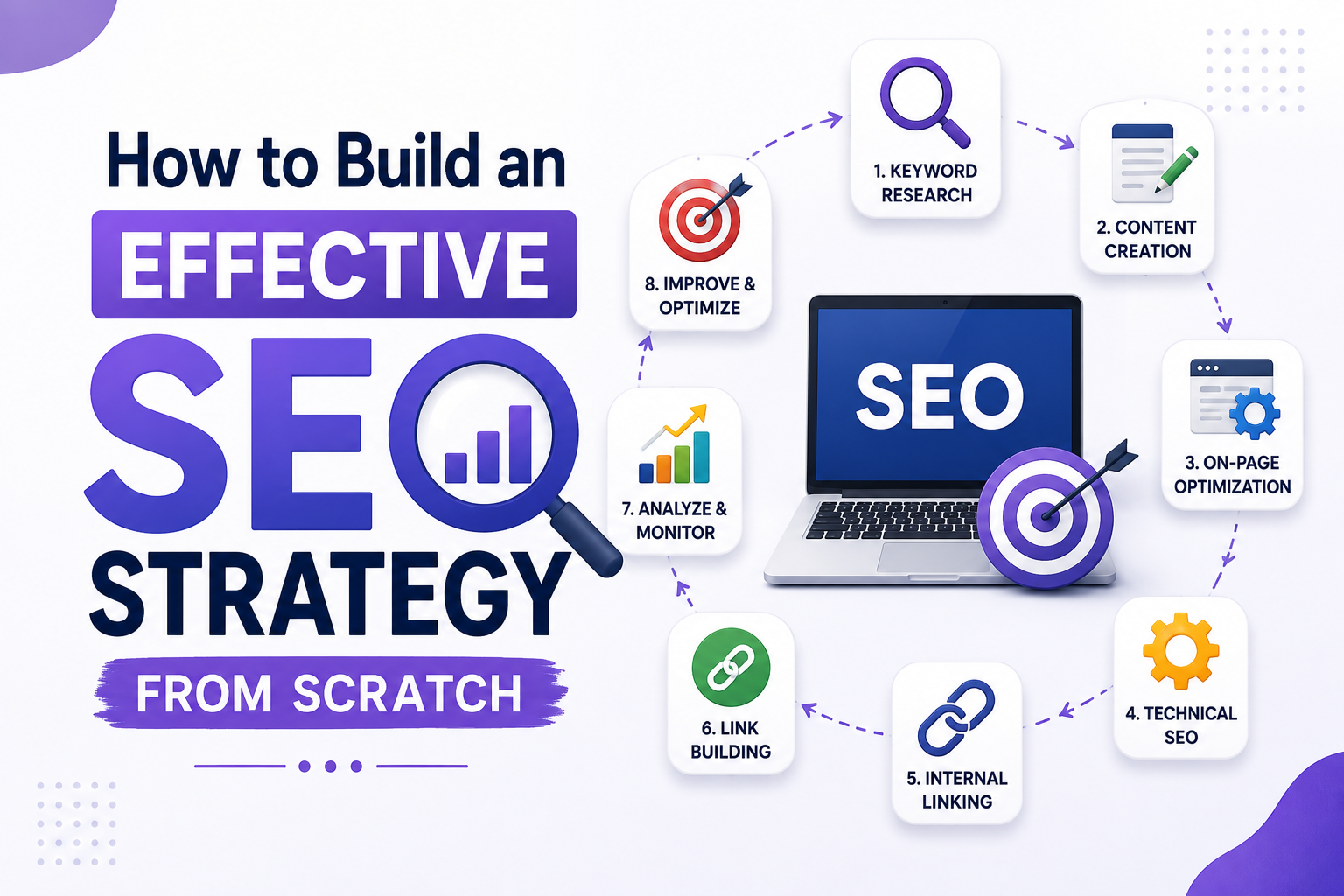
How to Build an Effective SEO Strategy From Scratch
Introduction
Building a strong online presence is essential for businesses, bloggers, and digital marketers who want to reach a larger audience. However, simply creating a website is not enough. Millions of websites compete for attention in search engine results, and without a clear optimization plan, even valuable content can remain unnoticed.
This is where Search Engine Optimization (SEO) becomes important. SEO is the process of improving a website so that search engines can understand its content and users can easily find relevant information. A successful SEO strategy combines keyword research, content creation, technical optimization, user experience, and performance analysis.
Creating an SEO strategy from scratch may seem complicated, especially for beginners. The good news is that SEO becomes easier when it is divided into clear and manageable steps. Instead of applying random optimization techniques, marketers should create a structured plan based on business goals and audience needs.
This guide explains how to build an effective SEO strategy from scratch and create a strong foundation for sustainable organic growth.
1. Define Your SEO Goals
The first step in creating an SEO strategy is defining clear goals. Without specific objectives, it becomes difficult to measure progress or determine whether your SEO efforts are successful.
Your SEO goals should support your overall business or website objectives. For example, an eCommerce website may want to increase product sales, while a blog may focus on growing organic traffic and building an audience.
Common SEO goals include increasing organic website traffic, improving keyword rankings, generating qualified leads, increasing online sales, improving brand visibility, and growing email subscribers.
Use specific and measurable goals whenever possible. Instead of saying, “I want more traffic,” set a goal such as increasing organic traffic by a realistic percentage within a defined period.
Clear goals help you prioritize tasks and measure the real impact of your SEO strategy.
2. Understand Your Target Audience
SEO is not only about search engines. It is mainly about understanding the people who use search engines to find information.
Before creating content, identify your ideal audience. Think about their interests, problems, questions, and online search behavior.
Ask questions such as:
Who is my target audience?
What problems are they trying to solve?
What information are they searching for?
Which products or services interest them?
What language do they use while searching?
Creating a simple audience profile can help you understand potential visitors more effectively.
For example, a website teaching digital marketing may target students, freelancers, small business owners, and beginner marketers. Each audience group may search for different information.
Understanding your audience allows you to create relevant content that matches their needs and search behavior.
3. Conduct Detailed Keyword Research
Keyword research is one of the most important parts of an effective SEO strategy. Keywords are the words and phrases people enter into search engines when looking for information.
Finding the right keywords helps you understand what your audience wants.
Start with broad topics related to your industry. Then, identify specific search terms connected to those topics.
For example, if your website focuses on SEO, potential keywords may include:
SEO tips for beginners
How to improve Google rankings
Keyword research techniques
On-page SEO checklist
Technical SEO guide
Long-tail keywords are particularly useful for new websites. These are longer and more specific search phrases that often have lower competition.
Instead of targeting a broad keyword like “SEO,” you could target “how to create an SEO strategy for a small business.”
When researching keywords, consider search volume, keyword difficulty, relevance, search intent, and competition.
The goal is not to target every popular keyword. Focus on keywords that are closely connected to your audience and website goals.
4. Analyze Search Intent
Search intent refers to the reason behind a user's search query. Understanding search intent is essential because search engines aim to provide the most relevant results.
There are four common types of search intent.
Informational Intent
The user wants to learn something.
Example: “What is technical SEO?”
Navigational Intent
The user wants to visit a specific website or online platform.
Commercial Intent
The user is researching products, tools, or services before making a decision.
Example: “Best SEO tools for beginners.”
Transactional Intent
The user is ready to complete an action, such as purchasing a product or subscribing to a service.
Before creating content, search your target keyword and analyze the type of pages appearing in search results. This helps you understand what users and search engines expect.
Matching content with search intent can significantly improve your chances of ranking.
5. Analyze Your SEO Competitors
Competitor research can provide valuable insights when creating an SEO strategy from scratch.
Your SEO competitors are websites ranking for the keywords you want to target. They may not always be your direct business competitors.
Analyze top-ranking websites and study their content.
Look at factors such as content length, heading structure, keyword usage, page format, internal links, backlinks, images, videos, and frequently asked questions.
The purpose of competitor analysis is not to copy existing content. Instead, identify opportunities to create something more useful.
Ask yourself:
What information is missing?
Can I explain the topic more clearly?
Can I provide updated examples?
Can I improve content structure?
Can I answer additional user questions?
Creating better value than competing pages can help your content stand out.
6. Create a Clear Website Structure
A well-organized website makes it easier for users and search engines to navigate your content.
Your website structure should be simple and logical.
For example:
Homepage → Main Category → Subcategory → Individual Page
Important pages should not be hidden deep within the website. Ideally, users should be able to reach important content within a few clicks.
Use descriptive navigation menus and create clear categories.
A strong website structure improves crawlability, internal linking, user experience, and content discovery.
Search engines use links to discover pages. Therefore, maintaining a logical site structure can support better indexing.
7. Create High-Quality SEO Content
Content is a central part of any SEO strategy. Search engines want to provide users with helpful, relevant, and reliable information.
Your content should directly answer the user's search query.
Before writing, create a content outline. Organize the article using a clear title, introduction, headings, subheadings, examples, FAQs, and conclusion.
Avoid creating content only to reach a specific word count. Every section should provide useful information.
High-quality SEO content should be original, easy to read, relevant, well-organized, informative, and focused on search intent.
Use your primary keyword naturally throughout the article. You can also include related keywords and phrases where they make sense.
Avoid keyword stuffing. Repeating keywords excessively can make content difficult to read and may negatively affect quality.
Write for people first while maintaining a search-friendly structure.
8. Optimize On-Page SEO Elements
On-page SEO involves optimizing individual pages to improve their search visibility.
Start by creating a clear and engaging title tag. The title should accurately describe the page topic and naturally include the primary keyword.
Write a compelling meta description that summarizes the content and encourages users to click.
Use one main H1 heading for the page. Organize other sections with H2 and H3 headings.
Create short, descriptive URLs. For example:
yourwebsite.com/build-seo-strategy
This is easier to understand than a long URL containing random numbers or unnecessary words.
Optimize images by compressing large files and adding descriptive alt text.
Internal links should connect users with other relevant pages on your website. External links may also be used when reliable sources add value to your content.
Strong on-page optimization helps search engines understand your page while improving readability for visitors.
9. Improve Technical SEO
Technical SEO focuses on the technical performance and accessibility of a website.
Search engines need to crawl and index your pages before they can appear in search results.
Start by checking whether important pages are indexable. Create an XML sitemap and ensure your robots.txt file does not accidentally block valuable content.
Improve website loading speed by compressing images, reducing unnecessary scripts, and using efficient website resources.
Your website should also be mobile-friendly. Users access websites through different screen sizes, so responsive design is essential.
Use HTTPS to protect data and provide a secure browsing experience.
Other technical SEO tasks include fixing broken links, managing redirects, checking canonical tags, improving Core Web Vitals, and identifying crawl errors.
Regular technical audits can help detect problems before they significantly affect website performance.
10. Build a Strong Internal Linking Strategy
Internal links connect one page of your website to another.
A strong internal linking strategy helps search engines discover content and understand relationships between pages.
For example, an article about keyword research can link to another guide about search intent.
Use descriptive anchor text that clearly explains the linked page.
Avoid using vague phrases such as “click here” whenever a more descriptive phrase can be used.
Internal links can also guide visitors toward important pages, increase page views, and improve website navigation.
When publishing new content, look for opportunities to link to existing relevant pages. You should also update older articles with links to new content.
11. Develop a Backlink Strategy
Backlinks are links from external websites to your website. Quality backlinks can strengthen website authority and improve search visibility.
However, backlink quality is more important than quantity.
Focus on earning links from trustworthy and relevant websites.
Effective backlink strategies include guest blogging, digital PR, expert contributions, original research, useful resources, and industry collaborations.
Creating valuable content naturally increases the chances of earning backlinks.
Avoid spammy link-building practices and low-quality link schemes. Sustainable SEO focuses on earning genuine links rather than manipulating rankings.
12. Improve User Experience
User experience plays an important role in website success.
Visitors should be able to find information easily and interact with your website without unnecessary difficulties.
Use clear navigation, readable fonts, short paragraphs, and enough spacing between content sections.
Avoid excessive pop-ups that interrupt users.
Make sure buttons and links work properly on mobile devices.
Page speed also affects user experience. Slow websites can frustrate visitors and cause them to leave before reading the content.
A positive user experience encourages visitors to explore more pages and engage with your website.
13. Track and Measure SEO Performance
SEO requires regular monitoring and improvement.
Tracking performance helps you understand which strategies are producing results.
Important SEO metrics include organic traffic, keyword rankings, clicks, impressions, click-through rate, conversions, indexed pages, and backlinks.
Google Search Console can help monitor search performance and indexing issues. Google Analytics can provide insights into website traffic and user behavior.
Review your SEO performance regularly.
If a page receives impressions but very few clicks, consider improving its title and meta description.
If rankings decline, review content quality, technical issues, and competitor activity.
SEO decisions should be based on data rather than assumptions.
14. Update and Improve Existing Content
Publishing new content is important, but updating existing content is equally valuable.
Older articles may contain outdated information, broken links, or missing details.
Review important content regularly and make necessary improvements.
You can add new sections, update examples, improve headings, include additional FAQs, replace outdated information, and strengthen internal links.
Content updates help maintain relevance and provide a better experience for users.
Instead of constantly creating new articles on similar topics, improving existing pages may sometimes produce better SEO results.
Frequently Asked Questions (FAQs)
1. What is an SEO strategy?
An SEO strategy is a structured plan designed to improve a website's visibility in organic search results. It combines keyword research, content optimization, technical SEO, link building, and performance analysis.
2. How do I start SEO from scratch?
Start by defining your goals, understanding your target audience, conducting keyword research, analyzing competitors, and fixing important technical issues. After building a strong foundation, create optimized content consistently.
3. How long does SEO take to work?
SEO results vary depending on website authority, competition, content quality, and technical performance. Significant improvements often require several months of consistent optimization.
4. Can I do SEO without paid tools?
Yes. Beginners can use free tools such as Google Search Console, Google Analytics, and Google Keyword Planner. Paid tools can provide additional data but are not required to start learning SEO.
5. Is keyword research necessary for SEO?
Yes. Keyword research helps you understand what your audience searches for and allows you to create content that matches their needs.
6. How often should I publish SEO content?
There is no universal publishing schedule. Focus on consistency and quality. Publishing one detailed and valuable article may be better than publishing several low-quality articles.
7. Are backlinks still important for SEO?
Yes, quality backlinks remain valuable for building website authority. Focus on earning relevant and trustworthy links rather than collecting large numbers of low-quality backlinks.
8. Why should I track SEO performance?
Tracking SEO performance helps identify successful strategies, discover problems, and make data-driven decisions to improve organic visibility.
Conclusion
Building an effective SEO strategy from scratch requires planning, patience, and continuous improvement. SEO is not a single technique or a quick solution. It is a combination of audience research, keyword planning, content creation, on-page optimization, technical improvements, internal linking, and authority building.
Start by defining clear SEO goals and understanding the people you want to reach. Conduct detailed keyword research and analyze search intent before creating content. Build a logical website structure and publish helpful content that genuinely answers user questions.
At the same time, maintain a technically healthy website, improve user experience, and develop natural internal and external links. Most importantly, track your results and use performance data to refine your strategy.
Search trends, competitors, and search engine systems continue to change. A successful SEO strategy should therefore remain flexible. Regularly review your website, update existing content, and look for new opportunities to provide better value.
By following a structured SEO process and focusing on long-term quality, you can gradually improve search visibility, attract relevant organic traffic, and create a strong digital presence.https://danishjamilseo.com/