
Blog
Master SEO: Top 5 Techniques for Long-Term Success

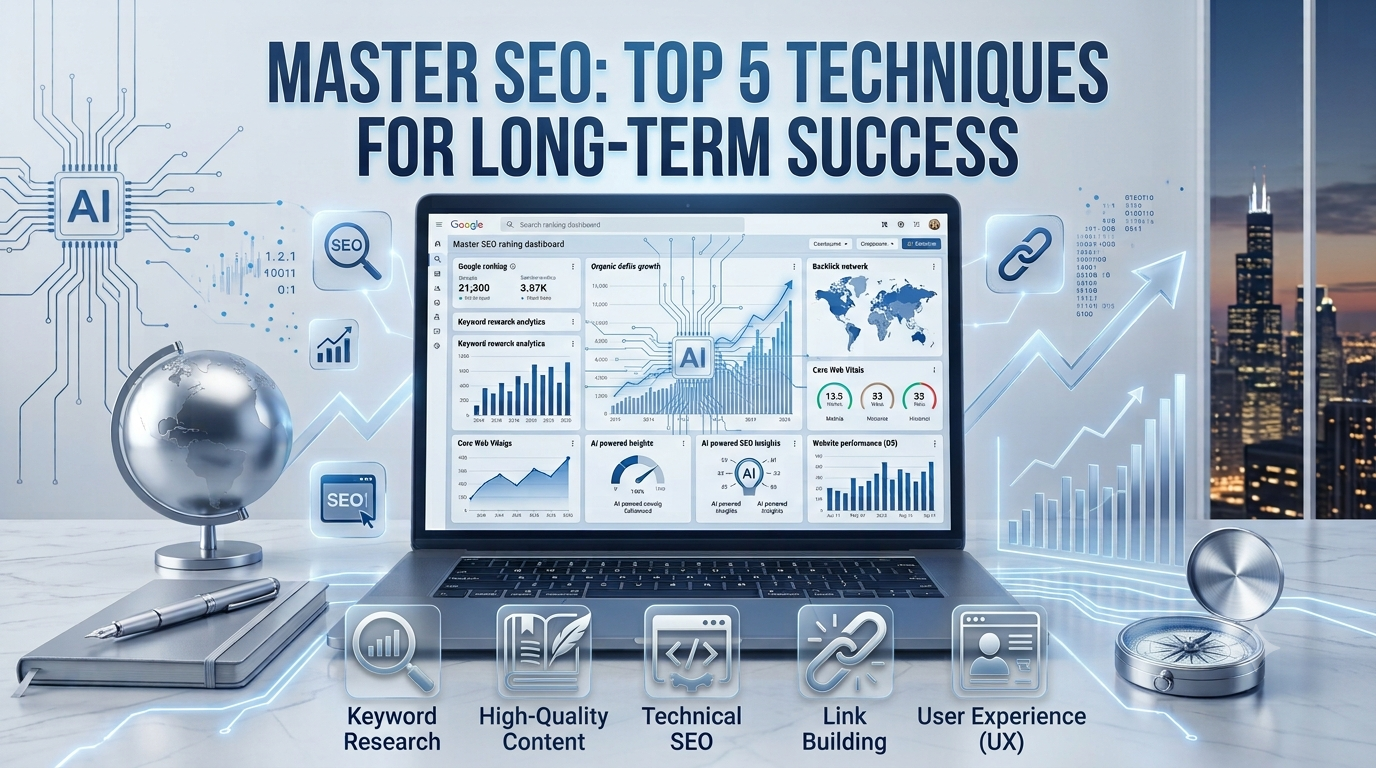
Master SEO: Top 5 Techniques for Long-Term Success
Introduction
Search Engine Optimization (SEO) has become one of the most important digital marketing strategies for businesses, entrepreneurs, bloggers, and content creators who want to build a strong online presence. While paid advertising can produce immediate traffic, its benefits often disappear as soon as the advertising budget runs out. SEO, on the other hand, provides sustainable, long-term results by helping websites earn visibility through organic search.
Google processes billions of searches every day, and users usually click on websites that appear on the first page of search results. Achieving those positions requires much more than simply adding keywords to a webpage. Modern SEO focuses on creating valuable content, delivering exceptional user experiences, optimizing website performance, and building trust through authority and relevance.
The search landscape continues to evolve with artificial intelligence, machine learning, and increasingly sophisticated ranking algorithms. As a result, businesses must adopt strategies that not only improve rankings today but also remain effective in the future. Long-term SEO success comes from consistency, quality, and continuous optimization rather than short-term tricks.
In this article, you’ll discover five proven SEO techniques that can help your website build lasting authority, improve search rankings, increase organic traffic, and maintain strong visibility in Google’s search results throughout 2026 and beyond.
1. Build Your SEO Strategy Around Search Intent
Modern SEO begins with understanding why users perform a search rather than simply identifying which keywords they use. This concept is known as search intent, and it has become one of Google’s most important ranking considerations.
Search intent generally falls into four categories:
Informational
Navigational
Commercial Investigation
Transactional
For example:
“How does SEO work?” indicates informational intent.
“Best SEO software” reflects commercial investigation.
“Hire an SEO consultant” shows transactional intent.
To optimize for search intent:
Research long-tail keywords.
Study the top-ranking pages.
Analyze Google’s “People Also Ask” section.
Answer related questions naturally.
Cover supporting subtopics within your content.
When your content satisfies user expectations, visitors remain on your website longer, interact with more pages, and send positive engagement signals that support better rankings.
2. Publish Valuable, Evergreen, and High-Quality Content
Content continues to be the foundation of successful SEO. However, Google’s Helpful Content System rewards websites that publish original, people-first content designed to educate, solve problems, and provide genuine value.
High-quality content should:
Be original and informative.
Solve user problems.
Include actionable advice.
Demonstrate expertise.
Remain easy to read.
Stay updated regularly.
One of the best long-term strategies is creating evergreen content—articles that remain useful long after publication.
Examples include:
Complete guides
Tutorials
Best practices
Industry resources
Educational content
A well-optimized article typically contains:
An engaging introduction
Logical headings
Short paragraphs
Bullet points
Practical examples
Internal links
FAQs
A compelling conclusion
Updating evergreen articles periodically with fresh examples and current information helps preserve rankings and extend their lifespan.
3. Strengthen Technical SEO for Sustainable Performance
Even the best content can struggle to rank if your website has technical issues. Technical SEO ensures search engines can efficiently crawl, understand, and index your website while delivering an outstanding experience for visitors.
Improve Website Speed
Fast-loading websites reduce bounce rates and improve user satisfaction.
Improve speed by:
Compressing images.
Using browser caching.
Reducing unnecessary CSS and JavaScript.
Choosing reliable hosting.
Implementing a Content Delivery Network (CDN).
Optimize for Mobile Users
Google uses mobile-first indexing, making responsive design essential.
Your website should:
Display correctly on all devices.
Load quickly.
Offer intuitive navigation.
Maintain readable typography.
Secure Your Website
HTTPS encryption improves trust and protects user information.
Improve Crawlability
Help search engines discover your content by:
Creating XML sitemaps.
Configuring robots.txt.
Eliminating duplicate pages.
Repairing broken links.
Optimize Core Web Vitals
Google evaluates:
Largest Contentful Paint (LCP)
Interaction to Next Paint (INP)
Cumulative Layout Shift (CLS)
Optimizing these metrics improves both rankings and user satisfaction.
4. Build Authority Through Quality Backlinks
Authority remains one of Google’s strongest ranking factors, and backlinks continue to play a major role in establishing credibility.
Rather than focusing on quantity, successful SEO emphasizes earning high-quality backlinks from relevant and trustworthy websites.
Effective backlink strategies include:
Guest Blogging
Contribute informative articles to respected websites within your niche.
Digital PR
Publish unique research, surveys, or case studies that journalists naturally reference.
Create Link-Worthy Resources
Develop valuable assets such as:
Free tools
Templates
Comprehensive guides
Industry reports
Checklists
These resources naturally attract backlinks over time.
Broken Link Building
Identify broken links on authoritative websites and recommend your relevant content as an alternative.
Avoid manipulative backlink schemes because they violate Google’s guidelines and may result in ranking penalties.
5. Continuously Optimize User Experience and On-Page SEO
SEO success depends not only on attracting visitors but also on providing an exceptional browsing experience.
Google increasingly measures how users interact with websites before determining rankings.
Optimize Title Tags
Create descriptive, engaging titles containing your primary keyword naturally.
Example:
Master SEO: Top 5 Techniques for Long-Term Success
Write Persuasive Meta Descriptions
A compelling meta description encourages users to click by explaining the page’s value.
Structure Content Effectively
Organize information using:
H1
H2
H3
Proper headings improve readability and search engine understanding.
Internal Linking
Connect related articles to improve navigation and distribute authority throughout your website.
Optimize Images
Improve image SEO by:
Compressing file sizes.
Writing descriptive filenames.
Adding meaningful alt text.
Improve Readability
Create user-friendly content with:
Short paragraphs.
Bullet points.
Clear formatting.
Simple language.
Visitors who enjoy using your website are more likely to remain engaged, return later, and recommend your content to others.
Additional SEO Best Practices for Long-Term Growth
To strengthen your overall SEO strategy, consider implementing these additional best practices:
Optimize for voice search.
Use Schema Markup to enhance search results.
Build topical authority around your niche.
Refresh outdated content regularly.
Monitor Google Search Console.
Track keyword performance consistently.
Improve accessibility for all users.
Analyze competitors.
Publish new content consistently.
Measure user engagement using analytics tools.
Together, these strategies create a resilient SEO foundation capable of adapting to future algorithm updates.
Frequently Asked Questions (FAQs)
1. What is long-term SEO?
Long-term SEO focuses on sustainable optimization strategies that continue delivering organic traffic and rankings over time rather than relying on short-term tactics.
2. Why is search intent important?
Search intent helps ensure your content matches what users are looking for, improving engagement and increasing ranking opportunities.
3. How long does SEO take to produce results?
Most websites begin seeing meaningful improvements within three to six months, depending on competition, website quality, and optimization efforts.
4. Are backlinks still important in 2026?
Yes. High-quality backlinks from authoritative websites remain one of Google’s strongest ranking signals.
5. What is evergreen content?
Evergreen content remains relevant and valuable for an extended period, continuing to attract organic traffic long after publication.
6. Does website speed affect SEO?
Absolutely. Fast-loading websites improve user experience, reduce bounce rates, and contribute positively to search rankings.
7. Should older content be updated?
Yes. Updating older articles with current information improves freshness, relevance, and search visibility.
8. Can beginners master SEO?
Yes. By consistently learning, practicing, and applying proven strategies, beginners can build strong SEO skills and achieve excellent long-term results.
Conclusion
Mastering SEO requires patience, consistency, and a commitment to providing genuine value to users. Modern search engine optimization is no longer about shortcuts or manipulating algorithms—it is about creating outstanding experiences that satisfy both users and search engines.
The five techniques discussed in this guide—understanding search intent, publishing evergreen content, strengthening technical SEO, earning quality backlinks, and optimizing user experience—provide a powerful framework for achieving long-term SEO success.
Businesses that continuously improve their websites, monitor performance, and adapt to evolving search engine standards are better positioned to maintain high rankings and attract consistent organic traffic. SEO is an ongoing investment that rewards quality, persistence, and strategic planning.
By implementing these proven methods, you can build a stronger online presence, increase website visibility, generate qualified traffic, and create sustainable growth that continues well into the future.