
Blog
Essential SEO Techniques for Long-Term Success image

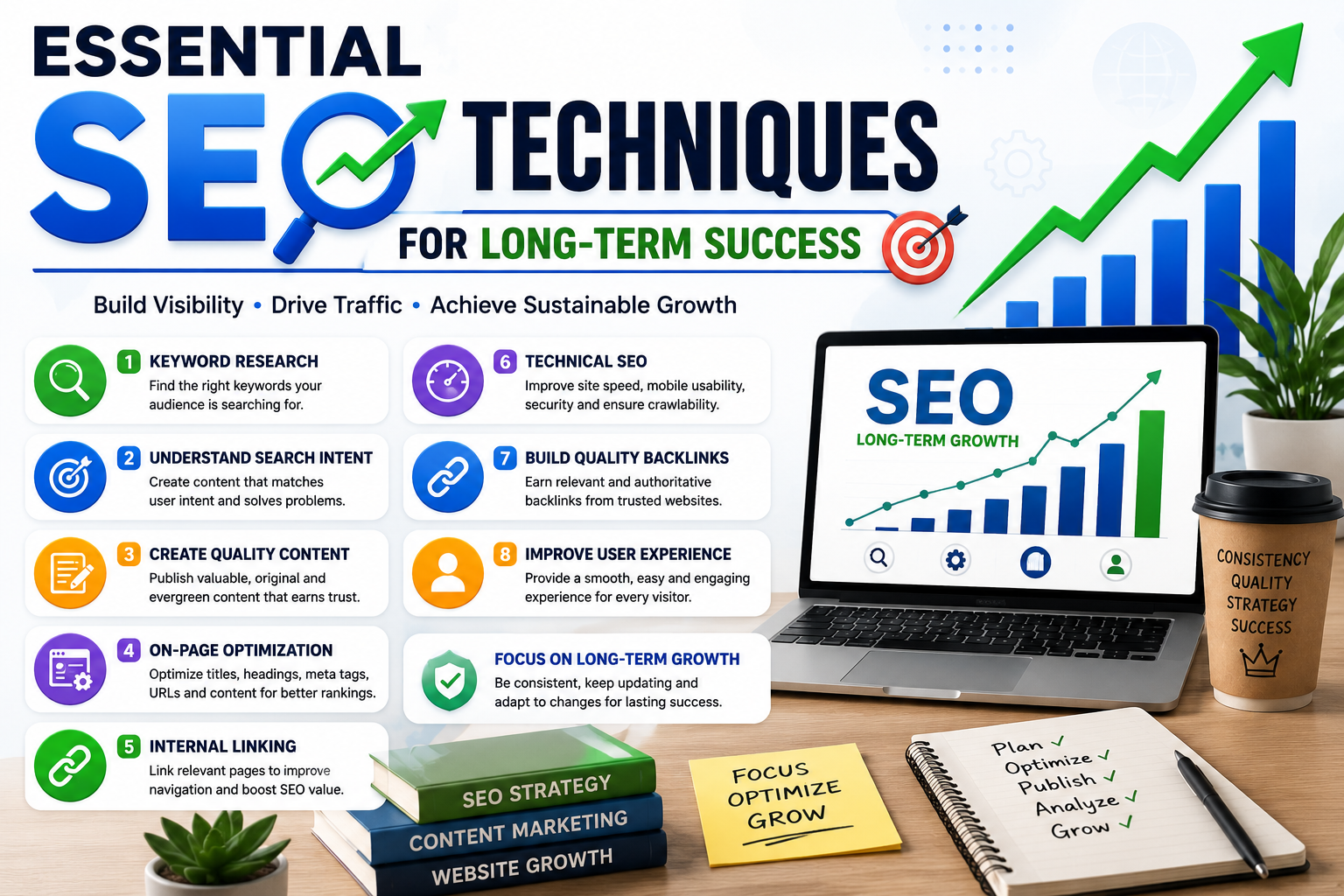
Essential SEO Techniques for Long-Term Success
Search Engine Optimization, commonly known as SEO, plays an important role in building a strong and sustainable online presence. Businesses, bloggers, marketers, and website owners use SEO to improve their visibility in search results and attract relevant visitors without depending entirely on paid advertising.
However, SEO is not a one-time task or a quick solution for instant rankings. Search engines continuously improve the way they understand websites, content, and user needs. Strategies that focus only on short-term results may fail to provide consistent growth. Long-term SEO success requires a combination of valuable content, technical improvements, strong website structure, and regular performance analysis.
A sustainable SEO strategy focuses on helping users find useful information while making it easier for search engines to discover and understand website content. Instead of searching for shortcuts, website owners should build a strong foundation that can support online growth over time.
This article explores essential SEO techniques for long-term success and explains how each strategy can contribute to better visibility, improved user experience, and sustainable organic growth.
1. Build a Strong Keyword Research Strategy
Keyword research is one of the most important elements of SEO. It helps you understand the words and phrases people use when searching for information online.
Without proper keyword research, content creators may spend hours writing articles that do not match the interests or needs of their target audience. A strategic approach allows you to identify relevant search opportunities and create content around topics people are actively exploring.
Start by identifying the main themes related to your website. For example, a digital marketing website may focus on SEO, content marketing, social media marketing, and paid advertising.
Once you identify your core topics, research specific keywords related to each category. Analyze factors such as relevance, search demand, competition, and user intent.
Long-tail keywords can be especially useful for sustainable SEO growth. These phrases are usually longer and more specific than broad keywords. For example, “SEO” is a broad keyword, while “essential SEO techniques for long-term success” is more specific.
Specific keywords often reveal clearer user needs and may attract more targeted visitors.
Keyword research should not be completed once and forgotten. Search behavior changes, industries develop, and new topics become popular. Regular keyword analysis can help you discover fresh opportunities and improve your content strategy.
The goal is to understand your audience's language and create useful content around relevant search topics.
2. Understand and Satisfy Search Intent
Search intent describes the purpose behind a user's search query. Understanding this purpose is essential for creating content that meets user expectations.
Imagine someone searching for “how to improve website SEO.” This user probably wants educational guidance and practical steps. A page that only promotes an SEO service may not provide the expected information.
Search intent is commonly divided into four categories: informational, navigational, commercial, and transactional.
Informational searches occur when users want to learn about a topic. Navigational searches help users find a specific website or online destination. Commercial searches involve product or service research, while transactional searches usually indicate that a user is ready to take action.
Before creating a page, analyze the main keyword and ask what the searcher wants to achieve.
You can also review the type of content commonly associated with a topic. Guides, tutorials, comparison articles, service pages, and product pages serve different user needs.
Your content format and information should match the searcher's expectations. If users want a beginner's guide, explain the topic clearly and avoid unnecessary complexity. If they want a comparison, provide useful differences and evaluation points.
Search intent should remain a central part of your long-term SEO strategy because search engines aim to provide relevant and helpful results.
3. Create Valuable and Evergreen Content
Content is a major part of sustainable SEO. Websites that consistently publish helpful information can build a strong library of resources for their audience.
Evergreen content is particularly useful for long-term SEO success. This type of content remains relevant for an extended period. Examples include beginner guides, educational resources, definitions, tutorials, and fundamental industry concepts.
However, evergreen content does not mean that an article should never be updated. Even valuable guides may require improvements as industries and user expectations change.
Focus on creating content that answers real questions. Before writing, research your audience and identify common problems, concerns, and information gaps.
Organize your content logically. Use a clear introduction to explain the topic and divide the main information into useful sections. Descriptive headings can help users quickly find the information they need.
Avoid adding unnecessary information simply to increase word count. Every section should have a purpose and contribute to the main topic.
Originality is equally important. Research can help you understand a subject, but your final content should use a unique structure, explanation, and perspective.
High-quality content can continue attracting relevant visitors over time, making it an essential part of long-term SEO growth.
4. Strengthen On-Page SEO
On-page SEO focuses on optimizing individual website pages. A well-optimized page makes it easier for users and search engines to understand the content.
Start with the page title. It should accurately describe the topic and naturally include the primary keyword when appropriate. Titles should be clear rather than misleading or overloaded with keywords.
Meta descriptions provide a short summary of a page. A useful description can communicate the value of the content and encourage searchers to explore the page.
Heading structure is another important on-page SEO element. Use one main H1 heading for the page title. H2 headings should organize major sections, while H3 headings can divide detailed subtopics.
Use keywords naturally throughout the content. Include related terms and phrases where they make sense, but avoid unnecessary repetition.
Page URLs should also be simple and descriptive. Short URLs that clearly represent the topic are usually easier for users to understand.
Images can be optimized with descriptive file names and relevant alt text. Alt text should explain the image accurately rather than being used only for keyword placement.
On-page SEO should support the reader's experience. Optimization techniques are most effective when they improve content clarity and organization.
5. Develop a Strategic Internal Linking Structure
Internal links connect pages within the same website. They are an essential part of website structure and can support long-term SEO performance.
When a visitor reads an article, relevant internal links can guide them to additional useful information. For example, an SEO basics article may link to separate guides about keyword research, technical SEO, or backlinks.
This creates a connected content experience and makes it easier for users to explore related topics.
Internal links also help search engines discover pages and understand relationships between different pieces of content.
Use descriptive anchor text when creating internal links. The clickable words should provide useful context about the linked page.
Avoid adding links randomly. Every internal link should have a clear purpose and connect relevant topics.
Content clusters can strengthen your internal linking strategy. A broad pillar page can cover a major topic, while supporting articles explore specific subtopics in greater detail. These pages can link to each other naturally.
Regularly review older content when publishing a new article. You may find opportunities to add links from existing pages to the new resource.
A thoughtful internal linking structure can improve website navigation and support a stronger long-term content strategy.
6. Focus on Technical SEO and Website Performance
Technical SEO focuses on the elements that help search engines access, crawl, and understand a website.
A website may contain excellent content, but technical problems can limit its visibility. Therefore, regular technical checks are important for sustainable SEO success.
Website speed is a key area to monitor. Large images, unnecessary scripts, excessive plugins, and heavy website designs can affect loading performance.
Compress images and remove unnecessary website elements. Review your website performance regularly and identify pages that load slowly.
Mobile usability is also important. Websites should adapt to smartphones, tablets, and different screen sizes. Text should remain readable, navigation should be simple, and buttons should be easy to use.
Search engines also need to discover and access important pages. A clear website structure and properly managed internal links can support content discovery.
Broken links and missing pages should be reviewed regularly. If visitors frequently reach error pages, the website experience can become frustrating.
Website security is another essential consideration. Using a secure connection helps protect information exchanged between users and websites.
Technical SEO can appear complicated to beginners, but learning the basic concepts can help prevent common website problems and build a stronger SEO foundation.
7. Earn Relevant and Authoritative Backlinks
Backlinks are links from external websites that point to your website. They can support online authority and help search engines understand relationships between websites.
However, long-term SEO success requires a quality-focused backlink strategy.
A large number of irrelevant or low-quality backlinks does not automatically create strong SEO performance. Focus on earning links from relevant and trustworthy websites.
Creating valuable content is one of the most sustainable link-building techniques. Detailed guides, original research, useful resources, statistics, and educational content can attract natural references.
Guest contributions may also help you connect with relevant audiences and industry websites. The main focus should be providing valuable information rather than simply gaining a link.
Digital relationships can create natural backlink opportunities. Connect with bloggers, industry professionals, content creators, and businesses within your field.
Broken link building is another useful technique. This involves identifying broken external links on relevant websites and suggesting a suitable resource as a replacement.
Avoid spammy link schemes and shortcuts. Sustainable link building takes time and requires genuine value.
Relevant backlinks can strengthen website credibility and support long-term organic visibility.
8. Improve User Experience
SEO and user experience are closely connected. A website should not only attract visitors but also make it easy for them to access information.
Start with clear navigation. Visitors should be able to understand the main website sections and find important pages without confusion.
Content readability is equally important. Use short paragraphs, descriptive headings, and simple sentence structures. Large blocks of text can make online content difficult to read.
Website design should support the content rather than distract from it. Excessive pop-ups, intrusive advertisements, and unnecessary visual elements may create a frustrating experience.
Make important information easy to find. If an article promises to answer a specific question, do not hide the answer beneath unrelated content.
Mobile users should receive the same level of usability as desktop visitors.
You should also consider accessibility when improving the website experience. Clear text, descriptive image information, and logical content structure can make websites easier to use.
A positive user experience can encourage visitors to explore additional pages and return to the website in the future.
Long-term SEO success is stronger when website optimization focuses on real people rather than search engines alone.
9. Update and Improve Existing Content
Publishing new articles is important, but existing content should not be ignored.
Over time, information can become outdated. Links may stop working, examples may lose relevance, and competitors may publish more comprehensive resources.
Regular content updates can help maintain the quality of your website.
Start by reviewing pages that previously generated organic traffic but have experienced a decline. Analyze the content and identify possible weaknesses.
Update outdated facts and improve unclear explanations. Add useful sections when the topic has developed or new questions have become important.
Review titles and headings to ensure they accurately represent the content. Check internal and external links and replace broken resources.
You can also improve readability by dividing large paragraphs and reorganizing complicated sections.
Content updates should provide genuine value. Simply changing the publication date without improving the article does not make the information more useful.
A regular content refresh strategy can help maintain a strong and reliable website resource library.
10. Monitor SEO Performance and Make Data-Based Decisions
Long-term SEO requires regular analysis. Without performance monitoring, it can be difficult to understand whether your strategy is producing meaningful results.
Track important SEO metrics such as organic traffic, search impressions, clicks, keyword visibility, and click-through rates.
Analyze which pages attract the most visitors and identify the topics that perform well. This information can guide future content planning.
Pages with high impressions but low clicks may require improved titles or search descriptions.
If a page loses traffic, review its content, technical performance, and search relevance. The solution may involve updating information, improving internal links, or better matching search intent.
Regular website audits can help identify broken links, indexing problems, duplicate pages, and other technical issues.
SEO decisions should be based on useful performance information rather than assumptions.
Remember that search performance can change over time. Competitors publish new content, user behavior evolves, and search systems continue to improve.
Continuous monitoring allows you to adjust your strategy and focus on techniques that create sustainable results.
Common SEO Mistakes to Avoid for Long-Term Success
Short-term SEO shortcuts can create problems for sustainable growth. Keyword stuffing is a common mistake that reduces content readability and creates an unnatural experience.
Publishing low-quality content only to increase the number of website pages is another ineffective approach. Quality should remain more important than content quantity.
Ignoring technical SEO can also limit website performance. Broken links, slow pages, and poor mobile usability should be addressed regularly.
Buying low-quality backlinks or participating in spammy link schemes can create unnecessary risks.
Another common mistake is failing to update old content. A strong article can lose relevance if the information becomes outdated.
Finally, avoid expecting immediate results. SEO requires patience, consistency, and continuous improvement.
FAQs About Essential SEO Techniques
1. What is the most important SEO technique for long-term success?
There is no single SEO technique that guarantees success. High-quality content, keyword research, technical SEO, user experience, and relevant backlinks work together to support sustainable growth.
2. How long does SEO take to show results?
SEO timelines vary depending on competition, website authority, content quality, and technical performance. Long-term SEO usually requires consistent optimization and regular monitoring.
3. Is keyword research still important for SEO?
Yes. Keyword research helps website owners understand search behavior and identify relevant content opportunities. The focus should be on user needs and search intent rather than keyword repetition.
4. Why is evergreen content important?
Evergreen content can remain useful for a long period and continue attracting relevant visitors. Regular updates can help maintain its accuracy and value.
5. Do backlinks help long-term SEO?
Relevant and authoritative backlinks can support website credibility and search visibility. Quality, context, and relevance are more important than backlink quantity.
6. How often should website content be updated?
There is no universal schedule. Content should be reviewed when information becomes outdated, performance declines, links break, or new valuable information becomes available.
7. Is technical SEO necessary for beginners?
Beginners should understand basic technical SEO concepts such as website speed, mobile usability, crawlability, indexing, security, and broken links.
8. Can SEO provide long-term website growth?
Yes. A sustainable SEO strategy can support long-term organic visibility when it focuses on valuable content, strong website performance, and continuous improvement.
Conclusion
Achieving long-term SEO success requires more than using a few keywords or publishing content regularly. Sustainable search visibility is built through a complete strategy that focuses on users, content quality, website performance, and continuous improvement.
Keyword research helps identify valuable search opportunities, while search intent ensures that content meets user expectations. Evergreen and helpful content can continue providing value over time, and strong on-page optimization makes information easier to understand.
Internal linking creates meaningful connections between website pages, while technical SEO supports accessibility and website performance. Relevant backlinks can strengthen online authority, and a positive user experience encourages visitors to explore content more easily.
Updating existing pages and monitoring SEO performance are equally important. Search behavior and online competition continue to change, so SEO strategies should evolve based on data and user needs.
The key to long-term SEO success is consistency. Avoid shortcuts and focus on creating a reliable, useful, and well-optimized website. By applying these essential SEO techniques regularly, website owners can build stronger organic visibility and create a sustainable foundation for future online growth.https://danishjamilseo.com/